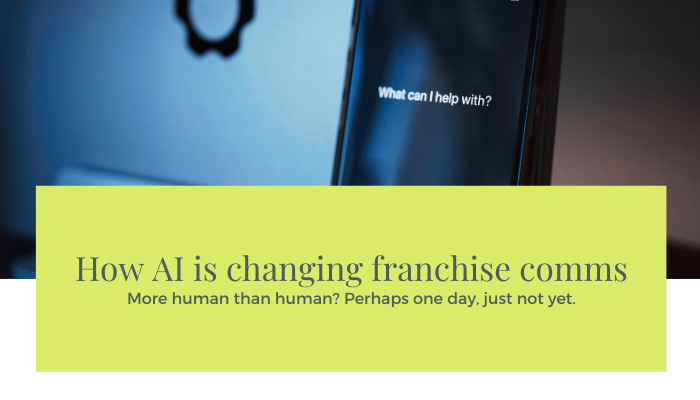
We don’t know about you, but we’re playing AI Lingo Bingo these days in the office. There seems to be a new phrase doing the rounds every week. Whatever the latest acronym or initialism, the overall message seems to be “AI is changing everything”. And that point at least, we concede.
The problem is that this change is bringing with it a tidal wave of bland, interchangeable, slightly-too-polished content that all sounds the same. You’ve seen it, we’ve seen it and, take it from us, journalists have definitely seen it! Some of the most common giveaways include:
- The “it’s not this, it’s that” structure: “It’s not just a business – it’s a lifestyle.” Or our personal favourite, “It’s not about profit – it’s about purpose.” (Usually followed by another version of the same line).
- Over-polished, under-informative headlines like, “Revolutionising the Future of Franchising” or “Redefining Success in a Changing Landscape”. Big words. Very little substance.
- Generic opening paragraphs, almost always starting with: “In today’s fast-paced world…”, “In an ever-evolving marketplace…”, or “As the industry continues to change…”. Yawn.
- Buzzword clustering. Phrases like innovative, scalable, dynamic, cutting-edge, best-in-class, industry-leading all crammed into one paragraph.
- The “motivational poster” tone. Everything sounds inspirational but nothing sounds specific because no one actually speaks like this in real life.
- Rev PR public enemy number one: the em dash. Not because humans don’t use dashes – good writers absolutely do (see!). But AI tends to use em dashes very frequently, dropping them mid-sentence instead of restructuring for better flow, and often pairs them with grand, sweeping statements for added drama.
Granted, none of this is disastrous on its own. But when you stack several of these together, you end up with content that feels manufactured and laughably inauthentic. And right now, so many businesses (not just in franchising) are edging dangerously close to a credibility problem. Not because AI exists, but because it’s being used without proper guardrails in place.
Before we go any further, let’s acknowledge the obvious irony here… We are a PR agency, writing a blog about how AI is diluting comms. Could be interpreted as somewhat self-serving, no? Happily, our ‘no BS’ promise to clients is a hill we’re prepared to die on, so strap in. And besides, this isn’t an anti-AI piece. It’s a pro-judgement one.
What does “pro-judgement” look like in practice?
It means recognising that AI is, at heart, a tool. A powerful one, yes. But still just a tool. And like any tool, it’s only ever as effective as the person wielding it.
Used well, it can be a genuine asset to franchise communications. It can help with research, structure, first drafts, idea generation, even sense-checking if you watch out for the odd hallucination. It can save time and can absolutely take some of the heavy lifting out of content creation. All good things.
Where it starts to unravel is when the thinking part is outsourced along with the typing part – because franchising is not a sector that lends itself to generic storytelling. At its best, it’s built on nuance. On founder backstories, the evolution of core businesses and on franchisee journeys that don’t follow neat templates. Almost every one of the 20+ brands we work with has a business model and financials that don’t fit comfortably into a single prompt.
The reason this matters is simple: people looking to invest in a franchise are not casually browsing. They’re weighing up (in their minds at least) significant risk and return, culture fit, leadership traits and longevity. If your content feels templated, the hesitation that results can stretch out decision-making timelines and sometimes even stop conversations before they really begin.
Journalists are having a similar experience. AI-assisted pitches are increasingly recognisable through rhythm and tone. This doesn’t mean they will dismiss anything that’s been touched by AI. But we have it on good authority (because they tell us!) that they’re more likely to give priority to pitches and stories that feel, yes, more human.
Authenticity has become more valuable than ever.
Right now, the brands cutting through are not the ones producing the most content so do be wary if that’s your strategy. Far better to produce fewer, more considered pieces and remember to pause long enough to ask, “does this actually sound like us?”, “would we say this out loud to a prospect?” and “does this reflect what’s really happening in our network?”.
That pause is where judgement lives. And it’s also where AI struggles. Technology is brilliant at recognising patterns. It’s not so good at understanding context, politics, reputation risk, sector history, or the subtle reasons why certain messages land well in franchising and others fall flat. That’s where your own and your team’s opinions and lived experience come in.
So, what now?
AI in PR and comms is fantastic for efficiency in the right places. But if we’ve said it once, we’ve said it a thousand times; trust is the backbone of franchise recruitment and it is not built by efficiency alone. If you’re a franchisor trying to navigate this sensibly, a few non-negotiables tend to make the difference.
First, positioning has to exist before the prompt does. If your leadership team can’t clearly articulate what differentiates your opportunity, AI won’t magically uncover it. It will simply rearrange what’s already there.
Second, someone still needs to own the voice. Not in theory, in practice. Who is reading recruitment copy and asking whether it genuinely reflects how the business operates? Who is checking that claims about support, earnings or growth align with reality? That responsibility can’t be outsourced to software.
Third, treat AI output as a starting point rather than a finished product. If a paragraph sounds impressive but could belong to three other brands in your sector, should you really be using it?
Fourth, lean harder into social proof. Think franchisee case studies and testimonials, network stats and milestones and commentary from leadership. These things are harder to generate synthetically, which is why they carry more weight.
And finally, resist the urge to increase volume just because you can. More content is only an advantage if it deepens trust rather than spreading it thin.
None of this is about rejecting technology because AI isn’t going anywhere. But as more brands lean on automation, the advantage will shift to those who use it intelligently. Over the next decade, the brands pulling ahead will be the ones building the strongest human connection, even if technology has helped shape the message.
More human than human? Perhaps one day. Just not yet.
If this resonates and you’d like to sense-check how AI is being used in your own comms, get in touch. Email our co-founder Lucy Archer on lucy@revpr.co.uk or call 07921 572554. If you suggest meeting for cake, we’ll pay.
Here at Rev, we regularly share articles about hot topics and offer PR advice to help you maximise your PR activities. Follow us on social media to stay updated: LinkedIn, Facebook or Instagram.